Will Your West Kelowna Garage Door Stop for a Child or Pet? Dry-Season Safety Tests
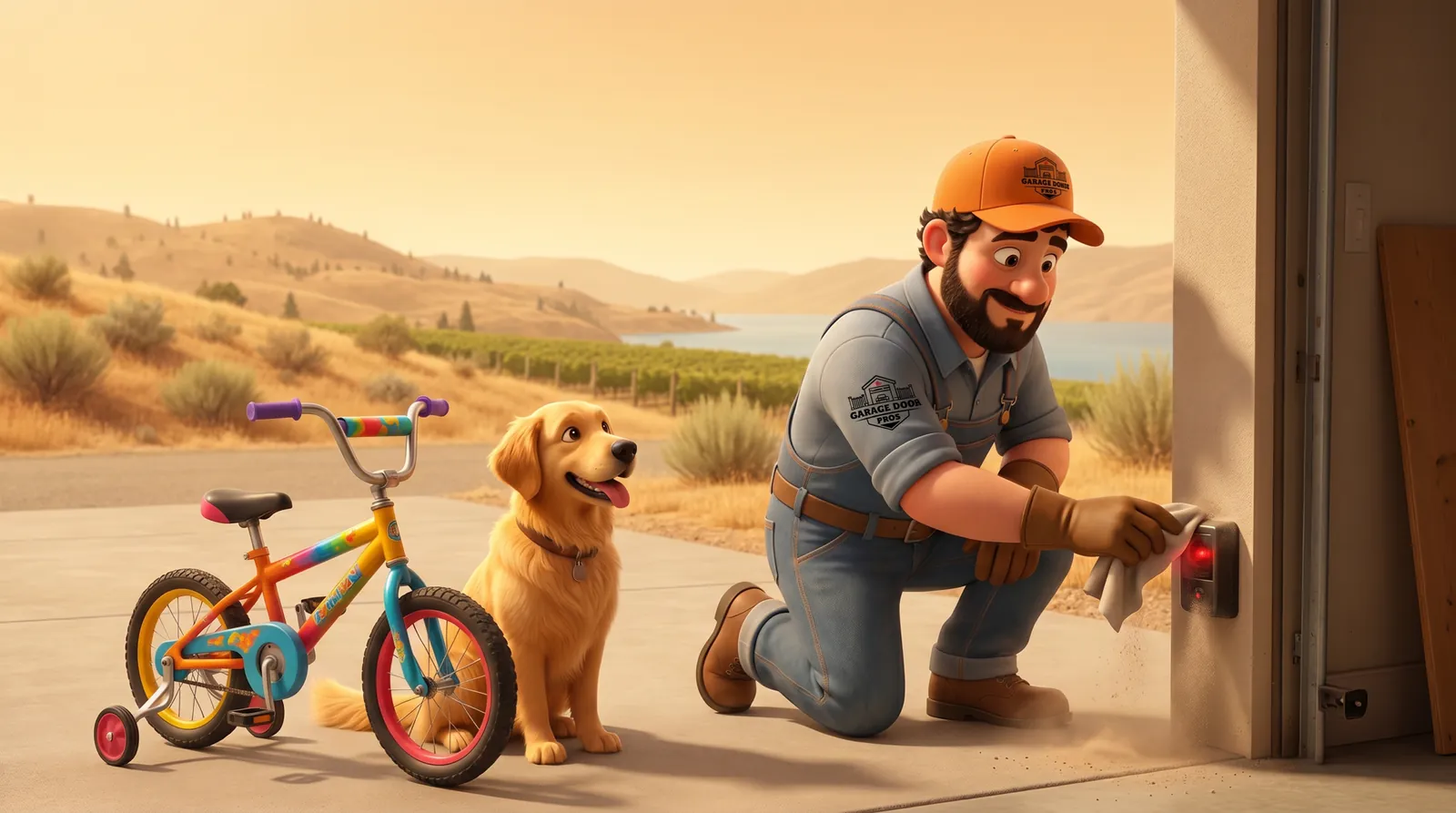
By the time August rolls around in West Kelowna, your garage door has spent months baking under intense Okanagan sun, breathing fine benchland dust, and in a smoky year, swallowing a season of wildfire ash drifting up off the valley. None of that announces itself with a dramatic failure. Instead, the door’s safety systems quietly drift out of spec, and the first time you find out is the day the door does not stop when it should. The systems built to protect a child, a pet, or a vehicle are exactly the ones that dry-season conditions degrade. Here are the two-minute tests that tell you whether yours still work.
The short answer: run two tests this month. First, the contact-reverse test, where the door must reverse the instant it touches an object on the floor. Second, the photo-eye beam test, where the door must refuse to close when something breaks the invisible beam near the floor. If either one fails, the door is unsafe to keep using until it is corrected.
The auto-reverse test that actually matters
Of every safety feature on your door, the contact-reverse mechanism is the one that protects against the worst outcome. It is what stops the door from crushing down on a toddler or a dog that wanders under it. A door that will not reverse on contact is the single most dangerous fault we find, and the Okanagan summer is hard on the settings that govern it.
Here is how to test it. Lay a flat 2x4 on the floor, lying down, in the center of the doorway, directly under the path of the closing door. If you do not have one, a roll of paper towel standing on end works just as well. Now close the door with the wall button and watch closely. The moment the bottom of the door touches the object, it should stop and reverse back up within a second or two. That is a pass.
If the door keeps pushing, crushes the paper towel, or simply stops dead without rolling back up, it has failed. Over a hot season, the opener’s force and sensitivity settings can drift, so the door pushes harder than it should before it senses resistance. That setting needs to be brought back into spec, and it is a core part of any garage door opener service we perform. Do not keep using a door that fails this test.
The photo-eye sensors and what dust and ash do to them
Down near the floor, about six inches up on each side of the doorway, sit the two photo-eye safety sensors. One sends an invisible infrared beam across the opening; the other receives it. If anything breaks that beam while the door is closing, the door reverses immediately. This is the second line of defense, and it is exquisitely sensitive to exactly the conditions an Okanagan summer delivers.
Fine valley dust settles on those lenses constantly out here, and in a wildfire-smoke year, a film of ash builds up faster than most people realize. A coated lens cannot read the beam cleanly, so you get one of two failures: the door refuses to close at all, or, more worryingly, the sensors get so confused they no longer reliably catch a real obstruction. Heat and the daily vibration of a long summer can also nudge a sensor out of alignment on its bracket.
Test the beam this way. Start the door closing, then wave a broom handle or your foot through the bottom of the doorway, breaking the beam between the two sensors. The door should reverse at once. If it does not, the first fix is simple: wipe both lenses with a soft, dry cloth to clear the dust and ash, then check that the small alignment LED on each sensor glows steady rather than blinking. A blinking light means the pair is out of alignment and needs to be re-aimed.
Your dry-season safety checklist
Run through these quick checks this month, and again after any dusty or smoky stretch of weather:
- Lay a 2x4 or paper-towel roll under the door and confirm it reverses on contact.
- Break the photo-eye beam during a close and confirm the door reverses immediately.
- Wipe both sensor lenses clean and confirm the alignment LEDs glow steady.
- Inspect the bottom rubber seal for sun-baked cracks and gaps that let it ride past obstructions.
- Look and listen for springs or cables fatigued by months of summer heat-cycling.
- Run the door up and down once and watch for rollers grabbing on grit in the track.
What the heat and grit do underneath
The safety tests above can pass and still leave you with components quietly worn by the season, and those feed back into how safely the door operates. Torsion springs are under enormous tension, and the repeated heat-cycling of an Okanagan summer, hot days and cooler nights, accelerates metal fatigue. A spring that snaps takes the door’s balance with it, and a poorly balanced door makes the opener work harder and confuses its force settings. The cables that pair with those springs fray under the same stress.
Down in the tracks, the same fine grit that fouls the sensor lenses works its way into the rollers, wearing them and making the door drag or hesitate as it travels. A dragging door can trick the opener into reading resistance as an obstruction, or, if the force is set too high to compensate, can mask a real one. The sun-baked bottom seal matters too: once it cracks and hardens, it no longer cushions the door’s contact with the floor, which is part of what a healthy reversal relies on.
Picture a West Kelowna family up on the benchland above the lake. Their door tested fine in spring, but after a hot, smoky July they notice it thumping down a little hard. They lay a 2x4 under it and the door crushes straight through without reversing. The cause turns out to be a drifted force setting plus a pair of ash-coated sensors, both straightforward to correct, but together they had quietly disabled the door’s protection. That is exactly the kind of fault a seasonal check catches before anyone gets hurt.
If your door fails either reversal test, the worn parts are best handled together. A full safety check folds neatly into regular garage door maintenance, and we run dedicated garage door maintenance in West Kelowna tuned to exactly these dry-season conditions. When a test reveals worn springs, frayed cables, or a door that grinds in its track, that crosses into garage door repair and, if grit has pushed a door off its tracks entirely, off-track door correction. To have your safety systems tested and brought back into spec, , call (778) 910-3106, or , and we will make sure the door stops the way it is supposed to.
Frequently Asked Questions
How do I test if my garage door will auto-reverse?
Lay a flat 2x4 on the floor in the center of the doorway, or stand a roll of paper towel on end, then close the door with the wall button. When the door touches the object it should stop and reverse back up within a second or two. If it keeps pushing, crushes the object, or stops without reversing, the safety system is out of spec and needs adjustment.
Why do my garage door safety sensors keep failing in summer?
The Okanagan dry season fills the air with fine valley dust and, in a bad year, wildfire ash, and both settle on the photo-eye lenses near the floor. A filmed-over lens can no longer read the infrared beam reliably, so the door either refuses to close or false-triggers. Heat and vibration can also nudge a sensor out of alignment over a long, hot summer.
How often should I test my garage door safety features?
Test the auto-reverse and the photo-eye sensors at least every month, and always after a dusty or smoky stretch of weather. These are the systems that protect a child, a pet, or a vehicle, so a two-minute monthly check is well worth it. A full professional safety inspection once a year keeps the springs, cables, and force settings in spec too.
Can fine dust or wildfire ash really stop my safety sensors from working?
Yes. The photo-eye sensors rely on a clean lens to send and receive an infrared beam, and a coating of valley dust or ash scatters that light. The result is a door that reverses for no reason, or worse, sensors so confused the door will not catch a real obstruction. A soft, dry wipe of both lenses is the first fix to try.
Why won't my garage door close all the way after a hot summer?
A long Okanagan summer heat-cycles the springs and bakes the bottom seal, and the opener's force and travel settings can drift over the season. The opener may sense resistance partway down from a gritty track or a stiff seal and reverse, reading it as an obstruction. Dirty or misaligned photo-eye sensors are the other common cause and the first thing to check.
Is it safe to keep using a garage door that won't auto-reverse?
No. A door that does not reverse on contact is the real danger to kids and pets, since it will keep pushing down on whatever is in its path. Do not disable or bypass the safety system to get the door working. Have the force settings and sensors checked and corrected so the reversal works the way it should.